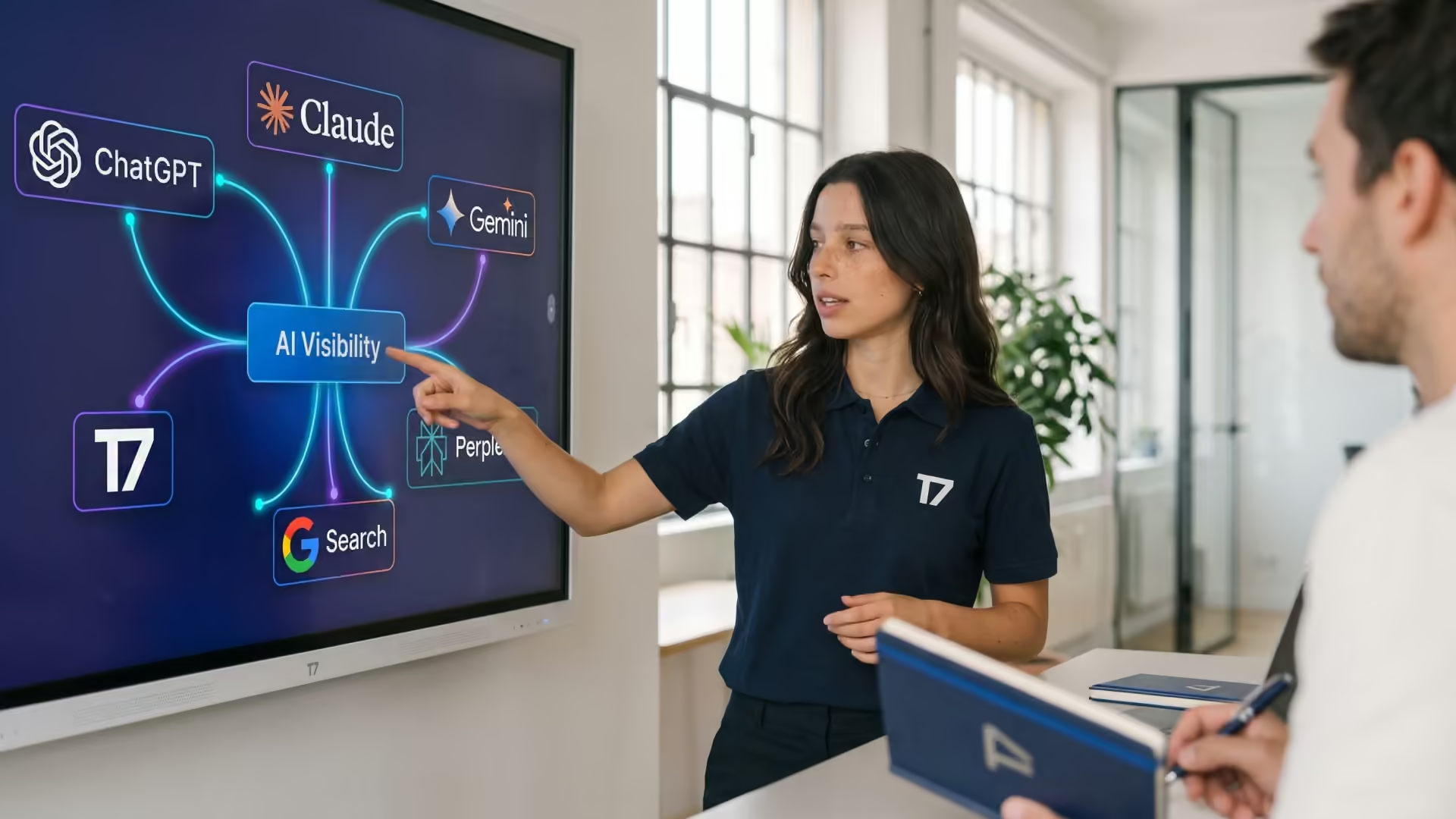
Discover who appears alongside you
Identify familiar competitors and other businesses that surface for the same customer questions.

Benchmark the businesses that appear when buyers research a service or market. You’ll get a competitor shortlist, a review of cited sources and a prioritised list of opportunities to act on.
Identify familiar competitors and other businesses that surface for the same customer questions.
Review cited sources and recurring topics across the questions sampled.
Turn the findings into a list of pages, business facts and sources worth improving.
A local buyer might ask “Which Limassol venues can host a 100-person corporate event?” A B2B buyer might ask “Which platforms support multi-location appointment booking?” We group questions like these by intent and market to see which businesses come up during discovery and comparison.

Compare your shortlist with businesses observed in the sampled answers. Label publishers and marketplaces separately from direct competitors.
Compare mentions and recommendations across matched question groups.
Identify cited pages and independent sources associated with competitor mentions. Check which source supports which claim when the answer makes that link clear.
Note recurring descriptions and content gaps, then prioritise actions by relevance, evidence and effort.
Illustrative sample · Limassol conference venues · 12 eligible answers to the same set of discovery questions
| Business | Mentions | Recommendations | Example source |
|---|---|---|---|
| Your venue | Named in 2 of 12 answers | Explicitly recommended in 1 of 12 | Example source: local venue directory. |
| Provider A | Named in 7 of 12 answers | Explicitly recommended in 5 of 12 | Example source: conference capacity page. |
| Provider B | Named in 4 of 12 answers | Explicitly recommended in 2 of 12 | Example source: regional events guide. |
Opportunity · Buyers asking about 100-person conferences need verified capacity by layout. Add a seating capacity table to the conference page and update any directory listings you manage with the same details.
If competitors repeatedly appear for questions about venue capacity, buying options or product integrations, we inspect the pages that buyers and AI answers can use to verify those details.
We review directories, media, marketplaces, partner pages and competitor websites cited in the sample. We identify which sources your team can update directly, which might merit outreach and which require further research.
We examine how answers describe competing offers, including the services, markets, specialisms or features they highlight. You can then see where to explain your own strengths more clearly.
We agree the market, service categories and known competitors. Then we sample buyer questions, review who appears and inspect the sources behind those answers. You receive a competitor shortlist, an evidence matrix, a summary of recurring sources and a prioritised list of opportunities.
A shortlist helps us understand the market. We can also identify other businesses that appear in the sampled answers.
We can trace available citations, review recurring patterns and identify plausible contributing factors. We label each inference separately from observed evidence.
Yes. We scope markets and languages in advance and report them separately so each comparison reflects the relevant buyer questions.
Use the action plan with your team or ask Studio 17 to scope GEO implementation. Monitoring can track a fixed subset of questions after changes are made.
We agree the markets, question groups and competitors before the project begins. A single-market benchmark can focus on one service, while a broader project can compare results across several markets and languages.
Yes. We can sample how buyers ask for your service in that market, identify the businesses that appear and review what sources buyers can use to compare them.

Share your website and the services or markets you want to benchmark.